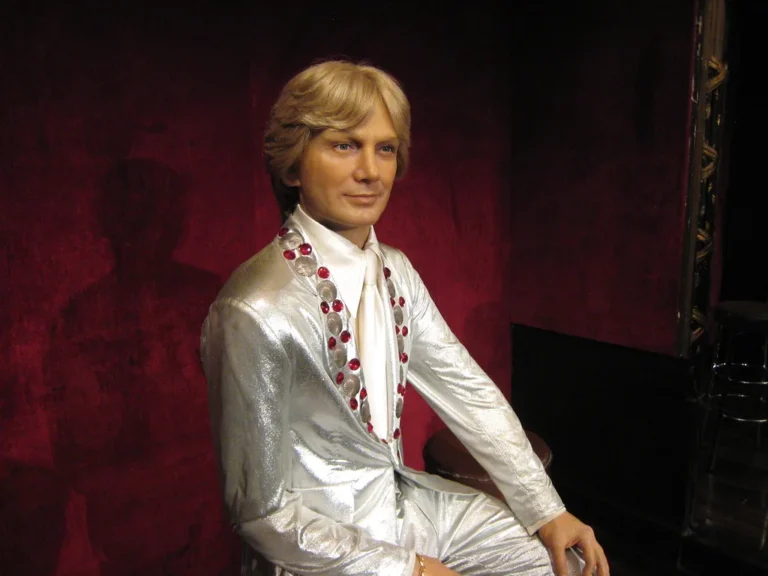

It is hard to talk about French popular music without mentioning Claude François, an artist who defined his era. His success was due not only to his hit songs but also to his stage shows. The arrival of his famous dancers, known as the Clodettes, marked a turning point in his career.
The beginning of this story dates back to the 1960s, when Claude François was starting to make a name for himself as a solo artist. Recruiting dancers to accompany his performances was an innovative idea at the time. Illustrator Michel Bourdais played a key role in the process: his drawings influenced the style and selection of the Clodettes.
The atmosphere of the 1960s encouraged bold stage shows. The Clodettes added a visual dimension to Claude François‘s concerts and helped bring about an artistic transformation. They represented a new era for the French music scene.
The origins of the Clodettes and their musical inspiration
James Brown’s concert at the Olympia in March 1966 was a decisive turning point for Claude François. The dynamic show and its striking choreography prompted him to rethink his stage presence. It was a time of innovation, and the singer saw the performance as an opportunity to create something distinctive.
The influence of that evening led him to bring dancers into his shows. Claude François devised a bold format combining music and choreography. This blend transformed his concerts and redefined expectations for the French music scene.
The influence of James Brown’s Olympia concert
In March 1966, Claude François attended James Brown’s concert at the Olympia. The show, with its dancers and carefully rehearsed choreography, gave him the idea of renewing his own act. The performers’ energy and coordination inspired a new artistic direction.
The first steps toward stage choreography
After the concert, Claude François began exploring new possibilities for his stage shows. He added dancers to his performances, creating a more visual and engaging spectacle. This approach attracted a wider audience and contributed to his growing success.
Claude François’s solo beginnings and evolving stage shows
Claude François began his solo music career in the 1960s. His artistic path was marked by constant change. At first he appeared onstage alone, but he gradually brought in dancers to energize his performances.
This change marked a turning point in his career. His shows evolved from a conventional format into rhythmic productions. The transition strengthened his image as a singer and redefined expectations for concerts in France.
| Development | Year | Details |
|---|---|---|
| Solo beginnings | 1962 | First hit with “Belles belles belles” |
| Stage transition | 1966 | Dancers join the act; show at the Olympia |
| Established success | 1969 | Sixteen days of shows at the Olympia |
1966 was a pivotal year, marked by the arrival of the dancers and the adoption of more elaborate staging. This change helped establish Claude François as a versatile performer.
Claude François and the Clodettes: who were his iconic dancers?
The arrival of the Clodettes marked a turning point in Claude François’s career. These dancers transformed his shows and redefined expectations for the French music scene.
Recruiting Solange Fitoussi and Siska Fitoussi
In 1966, Solange Fitoussi became the first Clodette. Her sister Siska soon joined her, forming a duo that would become iconic. Michel Bourdais, the illustrator behind the concept, played a key role in selecting the young women.
Michel Bourdais’s criteria and concept
Michel Bourdais looked for qualities beyond dancing ability. He favored youth, energy and a certain freshness. These criteria helped create a distinctive show combining choreography and music.
The arrival of the Clodettes energized Claude François’s concerts and attracted a wider audience. The innovative concept contributed to his growing success and marked a turning point in his career.
The artistic influence of his collaborators
Claude François’s collaborators played a central role in shaping his artistic identity. Michel Bourdais and Jean-Marie Périer stand out in particular.
Illustrator Michel Bourdais’s decisive role
Michel Bourdais, a talented illustrator, left his mark on Claude François’s story. His realistic illustrations captured the essence of the stage performances and helped explain the dance steps to the public. His work was essential in defining the Clodettes’ visual style and adding an artistic dimension to the shows.
Jean-Marie Périer and the creation of the iconic name
Jean-Marie Périer, meanwhile, played a decisive role in choosing the name “Clodettes”. Coined in 1966, the name became synonymous with dance and spectacle. That year marked an artistic turning point as choreography and music came together to create an unforgettable show.

These collaborations strengthened Claude François’s image and redefined stage conventions. His career benefited from this artistic partnership, which left its mark on the era.
| Collaborator | Contribution | Year |
|---|---|---|
| Michel Bourdais | Illustrations and visual style | 1966 |
| Jean-Marie Périer | The Clodettes’ name | 1966 |
Behind the scenes: choreography and intensive rehearsals
The success of Claude François’s shows rested on his music and on carefully rehearsed choreography. Behind the scenes, the work was demanding and directed by the singer himself.
Rehearsal methods and adapting the choreography
Rehearsals were intense, with entire days devoted to practice. The dancers had to learn and adapt movements quickly, sometimes in just a few days. This demanding pace was crucial to keeping the performances fresh and spontaneous.
The singer supervised these sessions personally, making sure every detail matched his artistic vision. It was a time of innovation, and the new choreography added a dynamic dimension to the shows.
The challenge of multiple costume changes
Numerous costume changes presented another major challenge. Some evenings called for as many as ten different outfits and quick transitions. Careful planning was essential to maintain the concert’s pace.
March, particularly in 1966, was a high point in the rehearsal calendar. It was a key period when every detail was refined, from the smallest choreographed movement to the final difficult passage of a song.
| Aspect | Details | Year |
|---|---|---|
| Choreography | Intensive rehearsals, quick adjustments | 1966 |
| Costumes | Ten outfits per concert, quick changes | 1966 |
| Rehearsals | Directed personally by the singer | 1966 |
These collective efforts, combining choreography and costumes, turned each show into an unforgettable experience. The dedication of the singer and his team redefined expectations for the French music scene.
To learn more about Claude François’s life and work, visit his official website.
Claude François through his contemporaries’ eyes and stories from the stage
Claude François’s career left an indelible mark on the history of French popular music. Contemporaries such as Alain Chamfort recall his charm and his obsession with the stage.
Alain Chamfort’s memories and other accounts
Alain Chamfort, who began his career alongside Claude François, recalls the atmosphere of the time with great emotion. He describes the singer as a charismatic figure who could captivate audiences with his powerful stage presence.
“Working with Claude meant entering a world where every detail mattered. He was obsessed with perfection, which made every show unique.”
These accounts highlight the complexity of relationships onstage. The dancers, some of whom went on to become singers, played a central role in that dynamic.
| Witness | Contribution | Year |
|---|---|---|
| Alain Chamfort | Account of Claude’s charm and obsession | 1966 |
| Dancers (Clodettes) | Contribution to the choreography and stage atmosphere | 1966 |
| Close collaborators | Support in preparing the shows | 1966 |
In March, at a key point in his career, Claude François experienced unforgettable moments. These stories, often told by those close to him, offer an intimate glimpse of his life and artistic legacy.
Conclusion
From his solo beginnings in the 1960s, the evolution of Claude François’s shows left its mark on the history of French popular music. Bringing in the Clodettes in 1966 transformed his concerts and redefined stage conventions.
This innovative concept, supported by collaborators such as Michel Bourdais and Jean-Marie Périer, made it possible to create a distinctive show. Through their energy and choreography, the Clodettes added a new visual dimension and attracted a wider audience.
Claude François’s legacy lives on through his iconic songs and the Clodettes’ influence on the performing arts. His career, though cut short by his premature death in 1978, continues to inspire many artists.
Discover more about Claude François’s final days and his lasting influence on French music.
FAQ
Who were the Clodettes, and what role did they play in Claude François’s career?
What inspired the creation of the Clodettes?
How were the Clodettes recruited?
What characterized the Clodettes’ choreography?
Who designed the Clodettes’ costumes?
What impact did the Clodettes have on Claude François’s shows?
Source links
- https://naydentodorov.com/en/people/claude-francois/
- https://www.claudefrancois.fr/en/claude-francois-and-his-claudettes-a-revolutionary-era/
- https://www.the-independent.com/news/world/europe/the-mystery-of-cloclo-did-he-write-my-way-and-was-he-killed-while-changing-a-lightbulb-793985.html
- https://www.timeout.com/movies/cloclo
- https://savethemusic.com/artist/claude-francois/
- https://abbaontv.com/programmes/1975/194
- https://www.filmfesthamburg.de/en/film-info/my-way/
- https://naydentodorov.com/en/people/claude-francois/
- https://www.mychansonfrancaise.com/claude-francois-profile
- https://www.tonyfrank.fr/en/artists/claude-francois
- https://www.claudefrancois.fr/en/alexandrie-alexandra-the-story-of-a-claude-francois-hit/
- https://www.irishtimes.com/culture/film/cloclo-1.1069632