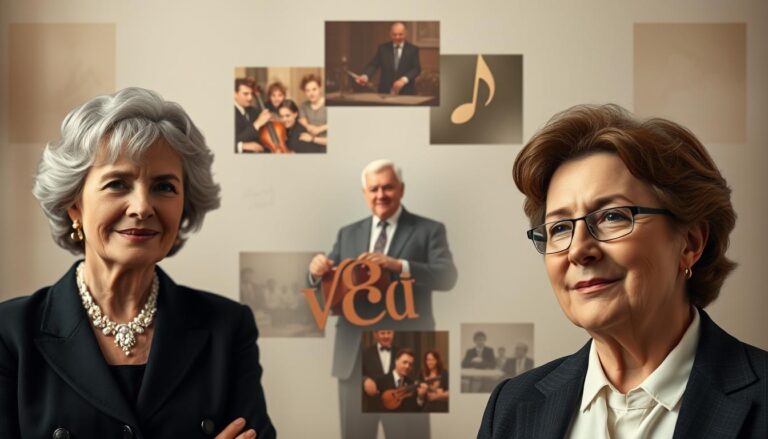

Objective: to give a factual account of the dancer and singer’s romantic relationship, with dated milestones and a clear distinction between facts and interpretations.
The couple often returns to the spotlight during commemorations, particularly around the 45th anniversary of the singer’s death (11 March 1978). Here we trace the chronology: their meeting in Monte Carlo in 1959, marriage in Monaco on 5 November 1960, move to Paris in 1961, the Olympia episode involving Gilbert Bécaud in 1962, the song “Je sais” in 1964, and their divorce, finalized on 13 March 1967.
This account draws on biographies and press articles. For readers, one promise: to understand why this story left its mark on Cloclo’s emotional life and on collective memory. For more biographical details and press coverage, see this dedicated article: testimony and key dates.
Why are people talking about Janet Woollacott and Claude François today?
Anniversaries of his death regularly renew interest in the singer’s private life. The 45th anniversary on 11 March prompted substantial media retrospectives.
The context of the commemorations
Every year, articles, slideshows and programmes revisit archival material. These occasions bring a range of perspectives and sponsored features. They also create space for advertising and sponsored content.
In 2023, an article published on 14 March brought photographs and accounts back into view. Commemorations sometimes last several days and increase online visibility.
A distinctive relationship in the singer’s love life
Among the other women in his life, she remains the singer’s only legal wife. That distinction attracts the attention of audiences and newsrooms.
- His former wife often becomes the starting point for accounts of the singer’s life before fame.
- Commemorations shape the narrative and the couple’s place in collective memory.
The following sections address these questions: who was she, how did they meet, why did they marry, and why did they separate in Paris?
Janet Woollacott: Who was Claude François’s former wife?
Originally from Nottinghamshire, Janet Woollacott was born on 4 November 1939 in Carlton. She was the daughter of Leonard Arthur Woollacott and Clarice Edith Burton. Her early years were rooted in Britain before she left for the French Riviera.
On the Riviera, she became a dancer in clubs and nightspots. Her work took her to the Sporting Monte-Carlo, where she was noticed. She then joined the ballet company directed by Arthur Plaschaert, which performed in major venues.
This experience shows an independent professional career beyond the label of someone’s wife. Her work included performances, rehearsals and regular engagements before she attracted media attention.

- Identity: Janet Edith Woollacott, her birth, parentage and British origins.
- Career: beginnings in clubs, discovery in Monte Carlo and Arthur Plaschaert’s ballet company.
- Clarification: fame came through her associations, but her artistic career began earlier.
For a fuller account, see the detailed biography, which sheds light on her life before the decisive meeting in Monte Carlo.
The meeting in Monte Carlo: The beginning of a relationship
Their artistic paths crossed amid Monaco’s nightlife in 1959. The Sporting Monte-Carlo brought together orchestras, ballet companies and stage shows.
The venue provides the context: lively clubs, rehearsals and backstage dressing rooms. Her presence as a dancer is documented; the musician was already moving in the same circles.
A youthful romance shaped by club life
Their relationship is described as a youthful romance born of nightlife and stage work. What is certain is that the date (1959) and place (Sporting Monte-Carlo) are documented.
This first encounter provides geographical and personal context. It also helps explain why Monaco became their base before they formalized their relationship.
| Element | Documented fact | Biographical interpretation |
|---|---|---|
| Place | Sporting Monte-Carlo, 1959 | A setting conducive to a youthful romance |
| Profession | Dancer in a ballet company | Artistic ambition as a daily bond |
| Context | Nighttime performances and orchestras | Industry pressures and professional proximity |
For more biographical information about this period, see this article on life after the stage: a life of dance and song.
Marriage in Monaco: Their union made official on 5 November 1960
The ceremony in Monaco on 5 November 1960 marks a key date in their lives.
An early marriage when the future singer was only 21
The wedding took place on 5 November 1960 in Monaco. Claude François was 21 when they married.
That young age invites questions. Such an early commitment makes more sense in the context of a career that was still uncertain.
Monaco, a family base and a symbol
Monaco had served as a base since the family settled there after 1956, following events connected with their exile.
Choosing the principality for their wedding also reflected a wish to be close to those around them and to find stability.
Family acceptance: according to sources from the period, the in-laws reportedly welcomed the news.
- Exact date and place: 5 November 1960, Monaco.
- Context: an early marriage and a career still taking shape.
- Family dimension: Monaco as a familiar place and a symbol of belonging.
| Event | Date | Significance |
|---|---|---|
| Wedding ceremony | 5 November 1960 | Official act and biographical milestone |
| Groom’s age | 21 | An early commitment amid uncertain prospects |
| Place | Monaco | Family base and symbol |
Note: the marriage did not guarantee lasting stability. Their move to Paris in 1961 would confront them with the realities of show business.
In Paris: Careers, dancing at the Olympia and the first tensions
The move to Paris in 1961 marked a turning point: artistic ambitions met professional realities. The young couple sought work there, but life in Paris revealed how tough the industry could be.
Moving to the capital in 1961: Ambition and the realities of the profession
Once in Paris, they had to attend numerous auditions and travel frequently. Their careers developed step by step, often without financial security.
Joining the ballet company at the Olympia
In 1962, Janet Woollacott was hired as a dancer in the ballet company accompanying Gilbert Bécaud at the Olympia. Appearing on that stage was an important step in her career.
The couple’s vulnerability in the entertainment world
The hours, rehearsals and travel contributed to tensions. In some accounts, the line between work and feelings became blurred.
The press and advertising sometimes magnify events. For archives and pictures, see this photo collection.
The following sections distinguish documented facts from biographical interpretations, particularly in accounts of Claude François, love and the singer’s reactions.
Janet Woollacott and Claude François: What we know about their relationship
Archives and biographies allow us to distinguish established facts from matters open to interpretation during this period.

The relationship with Gilbert Bécaud: What biographies report
According to several books, a professional closeness with Gilbert Bécaud may have developed into an affair. The sources describe a relationship that grew during tours and rehearsals.
“Je sais” (1964): A song associated with the breakup
The song, recorded in late 1964, is often linked to the breakup. Commentators note the association without establishing an indisputable causal connection.
Divorce finalized in March 1967: The official end of the marriage
The divorce was finalized on 13 March 1967. This legal act marked the official end of their marriage, though stories about it continued to circulate for years.
A trio whose relationships remained complex after the separation
According to one account of an encounter in September 1964, Bécaud and the dancer congratulated the singer in his dressing room at the Olympia. That moment illustrates the complexity of their relationships and challenges the idea of a simple betrayal.
“The sources call for caution: dated records on one hand, subjective readings on the other.”
| Element | Date | Main fact |
|---|---|---|
| Olympia engagement | 1962 | Public exposure and professional life |
| Recording | Late 1964 | “Je sais” associated with the tensions |
| Divorce | 13 March 1967 | Legal act of separation |
For press coverage and images, see this detailed article on the commemorations and biographical milestones.
After Cloclo: Janet’s life, her daughter Jennifer and her other relationships
The next chapter of her life centered on motherhood and a deliberately less public existence.
Jennifer, born in 1968, is often described as the daughter of Janet’s subsequent relationship. Her parentage remains the subject of numerous articles and profiles.
A central role: Her daughter and other children close to the family
After the separation, her daughter’s presence influenced her personal choices. The singer later had two sons, Claude Jr. and Marc, reshaping the family dynamics.
Marriages, career and legacy
Several marriages, to Jean-Paul Barkoff, Jean Sarrus and Dominique Perrier, marked her life. She also turned to singing, recording songs mentioned in sources and collaborating with Dominique Perrier.
In 1998, years after these events, a book described as an account of the forgotten years was published. It contributes to her legacy and to the biographical information available online.
“Archives and online articles sometimes simplify a more complex story.”
She died in November 2011; her funeral took place in Clamart, and she was then buried in the municipal cemetery. Sources differ on her age (72 or 73), so biographical notices treat it cautiously.
Conclusion
: the key dates are their meeting in 1959, marriage in 1960, move to Paris in 1961, the Olympia and Bécaud in 1962, recording of “Je sais” in 1964, divorce in March 1967, Jennifer’s birth in 1968, her account published in 1998, her death in November 2011 and burial in Clamart.
This chronology helps explain the lasting interest in their story: a youthful romance, the singer’s only marriage and an artistic turning point on major Parisian stages.
The human reality remains nuanced. It cannot be reduced to a simple betrayal or a legend. Some sources describe calmer relations after the separation.
An important clarification: Janet Woollacott had an artistic career of her own and published a book in 1998 that helped shape public memory.
For further reading, see this in-depth overview. Check the sources and distinguish established facts from media retellings over the years.