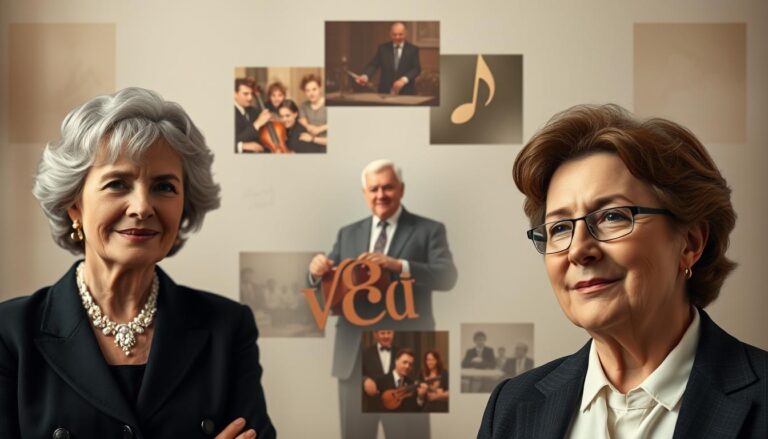

A brief reminder: around anniversaries and renewed media interest in March 2023, the question regularly resurfaces. Profiles first mention a famous marriage, then a second major relationship.
In this article, we present a biographical portrait based on dated facts and sources (books, television documentaries and accounts), clearly distinguishing established details from uncertainties.
Context: France in the 1950s and 1960s, and the entertainment world in Monte Carlo, Paris and the Olympia. Claude François’s fame often provides the historical backdrop.
Our aim is simple: to explain whom she married, why their relationship deteriorated and how Gilbert Bécaud entered her life. We avoid reducing a professional dancer to a supporting role.
Who was Janet Woollacott’s husband? What the biographies say
To understand her romantic life, we must first return to the wedding held in Monaco in November 1960.
Claude François, her only official husband
Established fact: Claude François remains her only official husband. The civil and religious wedding took place in Monaco on 5 November 1960.
Books and personal accounts confirm this milestone. Janet Woollacott appears in them as the only woman he married.
Why documentaries often revisit the marriage
Reports, including Archives secrètes (France 3), regularly revisit this episode.
They seek to portray the famous singer’s earlier life and explore its tensions and uncertainties. Claude François’s reputation as a flirt and a womanizer adds to the appeal of these accounts.
- Janet is presented as a pivotal figure in his rise to fame.
- Media interest returns around anniversaries and repeat broadcasts.
- Biographies distinguish her legal husband from her later partner, Gilbert Bécaud.
| Item | Detail | Source |
|---|---|---|
| Marriage | 5 November 1960, Monaco | Civil records and biographical accounts |
| Status | His only official wife | Books and personal accounts |
| Media coverage | Documentaries, anniversaries, photo galleries | Recent reports |
Janet Woollacott, a British dancer before fame
Her stage career goes a long way toward explaining how she met young singers on the rise.
Training and company: the British dancer began her career with Arthur Plaschaert’s ballets. Life in a company demanded discipline, rehearsals and commitment on stage.
Her beginnings in Arthur Plaschaert’s ballets
Joining a recognized company was a real springboard. Its shows offered exposure and contacts.
The setting of major venues and variety shows in France
The company regularly performed in major venues, including the Olympia. Television appearances and variety shows gave each performer more opportunities to become known.
An artist at the heart of Parisian entertainment in the late 1950s
By the late 1950s, she already had experience. Tours, rehearsals and backstage encounters helped her build a network.
This period explains why an experienced dancer could attract the attention of an ambitious young singer. Later, these encounters would become material for stories and biographies.
Meeting Claude François at the Sporting Monte-Carlo
They met amid the bustle of the Sporting Monte-Carlo, between performances and backstage activity. This landmark on the French Riviera brought together artists, promoters and wealthy audiences.
The late 1950s: a turning point for the couple
In the late 1950s, those years proved decisive. Janet Woollacott was already an accomplished dancer. Claude François was finding his way and looking for opportunities.
An ambitious young singer and a professional dancer
Personal accounts, including Christine Reynolds’s contribution to a documentary, describe a direct approach. He invited her out after the show, and the chemistry was immediate.
“He came to see her, straightforward and determined; she was charmed by him from the very first day.”
The contrast between their circumstances shaped their relationship: an established artist and a singer on the rise. Their connection quickly moved beyond work and became intimate.
| Place | Period | First step |
|---|---|---|
| Sporting Monte-Carlo | Late 1950s | Invitation after the show |
| Monaco (symbolic) | Preparations for marriage | Plan to move to Paris |
| Impact | Career advancement | Future tensions and pressures |
Monaco often features in accounts of both their meeting and their marriage. To learn more about the singer’s career, see the profile of Claude François.
A wedding in Monaco in November 1960
On 5 November 1960, a civil union was celebrated in Monaco. This marriage remains the only documented official union for Claude François.
“I do” on 5 November 1960: accounts and facts
Sources emphasize the precise date and legal status: a ceremony in Monaco that formalized the relationship. At the time, the future singer was in his twenties and still finding his way.
The move to Paris: hopes and early tensions
After the wedding, the couple moved to Paris, hoping to make their mark. His career ambitions drew him toward the Olympia and television contracts. The gap between dreams and reality soon caused tensions.
Janet’s role in Claude François’s rise
Janet was more than his wife: she already knew the entertainment world and supported him. Her stage experience helped the emerging singer, while the pressure of success strained their marriage.
| Item | Detail | Impact |
|---|---|---|
| Date | 5 November 1960 | Biographical milestone |
| Place | Monaco | Official union |
| Consequence | Move to Paris | Opportunities and tensions |
For more on this period, see the profile of Janet Woollacott.
Inside the marriage: jealousy, control and crisis
Confidences reported in a documentary reveal a tense and often troubled daily life. Archives secrètes (France 3) is the source of several accounts that have circulated since.
The account of Christine Reynolds, Janet’s best friend
Christine Reynolds, described as her best friend, recounts scenes from everyday life. She describes arguments sparked by glances and reproaches over going out.
“He locked her in”: an account of controlling behavior
One episode from the documentary is often repeated: the phrase “he locked her in” illustrates a desire for control. This image is used as a sign of a marital crisis.
Watched backstage: work and conflict
The account also shows how her professional life became a source of tension. The singer stayed backstage to watch her, turning her workplace into a place of suspicion.
- Sources: a documentary and the account of someone close to her.
- Behavior: jealousy, angry outbursts and restrictions on her freedom.
- Consequence: a possible later break, followed by the start of another relationship.

Gilbert Bécaud: the meeting that changed everything
A job at the Olympia quickly turned a working relationship into an intimate bond. Hired as a dancer for his concerts, Janet saw the singer every day. Rehearsals and evenings together brought them close.

Janet at the Olympia: from collaboration to romance
The relationship began on stage, amid choreography and improvisation. Sources indicate that their bond grew beyond a strictly professional relationship.
Why Bécaud attracted her: a “zest for life” and a lighthearted spirit
People close to them, including Christine Reynolds, describe Bécaud as cheerful and radiant. His “zest for life” was readily appealing.
“He had a carefree spirit that charmed her.”
The separation and the gradual end of the marriage
The new relationship heightened tensions. Living together became difficult, they separated in practice, and legal proceedings followed.
- Setting: the Olympia and daily rehearsals.
- Transition: from a professional bond to a romantic one.
- Consequence: the beginnings of a separation and preparations for divorce.
Divorce, a tribute song and Jennifer’s story
The years following the separation brought together songs, legal proceedings and controversy surrounding a child born in 1965.
“Je sais” (1964): a song interpreted as a tribute
Je sais (1964) is often described in accounts as a song paying tribute to Janet. Some commentators see it as a personal response to the tensions.
The divorce finalized in 1967 and new beginnings
The divorce was officially finalized in 1967. This turning point marked a legal and symbolic separation.
Each rebuilt a life: one focused on work, while the other began a new romantic and professional chapter.
Jennifer (1965): birth, acknowledgment and uncertainties
Jennifer was born in 1965. Sources describe a widely reported story about the surname borne by the daughter.
A documentary reports that the child bore the surname “François” for six years, following a registration at the town hall attributed to Claude François. It then mentions a later acknowledgment by Gilbert Bécaud.
After this period: Claude François’s romantic life
Claude François later began a relationship with Isabelle Forêt. They had two sons: Claude Junior and Marc.
This chapter is described as a symbolic gesture, sometimes presented as an act of revenge and often repeated in documentary promotions.
To explore Gilbert Bécaud’s role during this period, archives and personal accounts remain useful sources.
Conclusion
The finding: the man officially married to Janet Woollacott was Claude François, while the other major figure in her romantic life mentioned in these accounts was Gilbert Bécaud.
Key dates: their meeting in the late 1950s, marriage in 1960, subsequent tensions, the song Je sais (1964), Jennifer’s birth in 1965 and the divorce finalized in 1967.
Documentaries and television profiles sustain public interest. They present accounts and images again, sometimes without resolving questions of motive and interpretation.
Beyond the celebrity story, this history illustrates power dynamics, the demands of the entertainment industry and the effect of fame on private life. To learn more, consult records, archives and specialist books to distinguish dated facts from interpretations.